Replacement & Installation
Tile roof replacement and relay in San Jose
Concrete tile can outlast the paper under it by decades. When the underlayment goes, the choice is a lift-and-relay with your existing tile or a new tile roof, and we price both.

What we treat
- Concrete and clay tile
- Composition shingle
- Flat, torch-down and TPO
- Spray foam
- Standing seam metal
Quick answer. Tile roof replacement in San Jose usually starts with the underlayment, not the tile: sound concrete or clay tiles are lifted, stacked, and relaid over new underlayment and battens, while broken or brittle field tile is replaced with a matching or new profile. A full new tile roof is quoted when the old tile is failing or a lighter profile is wanted.
Updated September 2026
The job
Why tile roofs fail from underneath
A concrete tile can last fifty years, but the felt or early synthetic beneath it often gives out in twenty to thirty. Water that slips past a tile is supposed to drain off that layer; once it cracks, the leak appears with every tile still in place.
The relay keeps the look of the house and reuses the heaviest, most expensive part of the roof. It only makes sense when enough tile survives the lift. Where too many crack, or the homeowner wants a lighter or cooler-rated roof, we quote a new tile system alongside it.
Your options
Relay the old tile or put on a new tile roof?
The salvage count usually decides it.
| Question | Lift and relay | New concrete tile | Switch to metal |
|---|---|---|---|
| When it fits | Most tile sound, underlayment failed | Tile brittle or profile discontinued | Framing marginal or want less weight |
| Street look | Unchanged | Close to original | Stone-coated profiles mimic tile |
| Weight | Same as before | Often a little lighter | Much lighter |
| Relative cost | Lowest of the three | Higher | Highest |
Jobs this page covers
Concrete tile re-roof
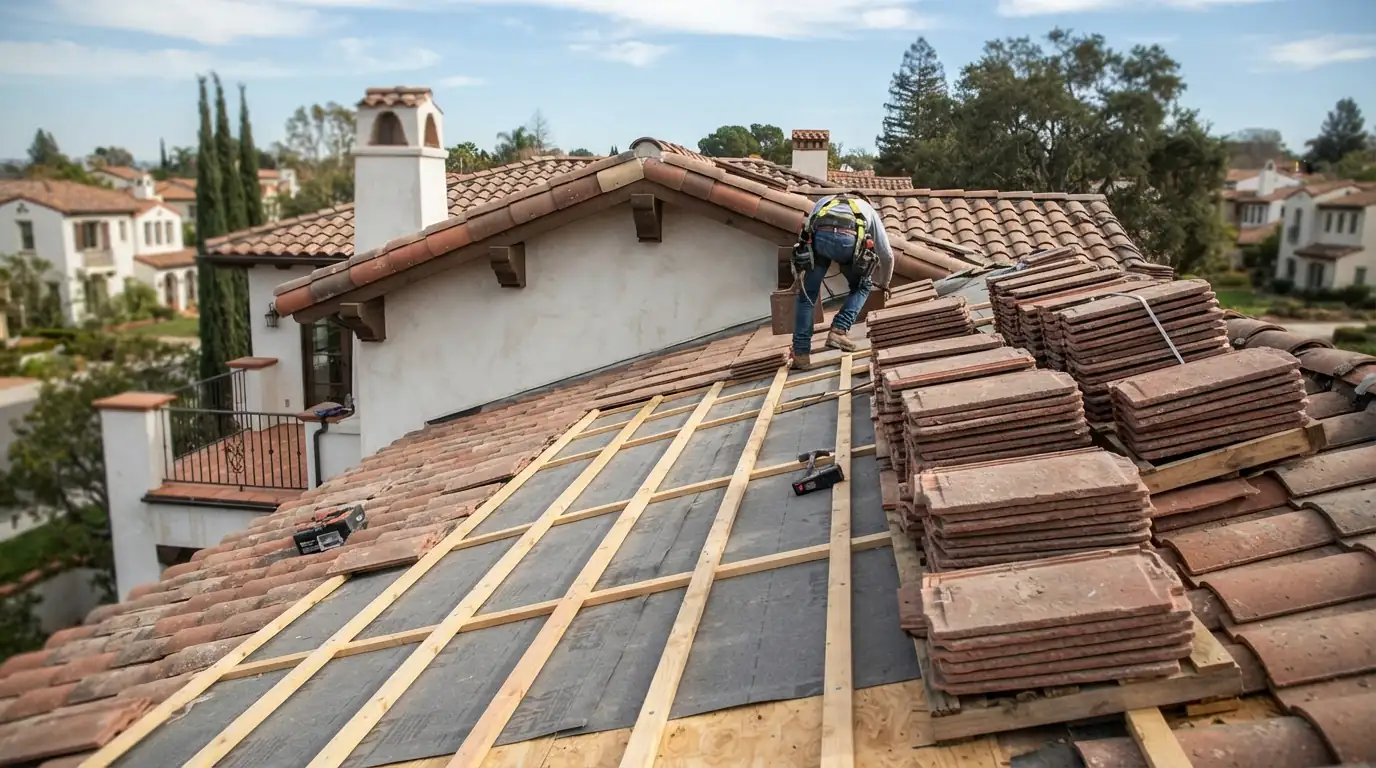
Flat and S-profile concrete tiles are the most common tile roofs we see. A full re-roof strips the old tile and battens, replaces the underlayment with a high-temperature synthetic or a two-ply system, installs new battens and flashing, and lays new tile from Eagle or Westlake Royal in a profile and color close to the original. New tile is usually lighter per square than 1980s product, which helps when the framing is marginal. Bird stops and new eave closures go in at the first course.
Clay tile re-roof
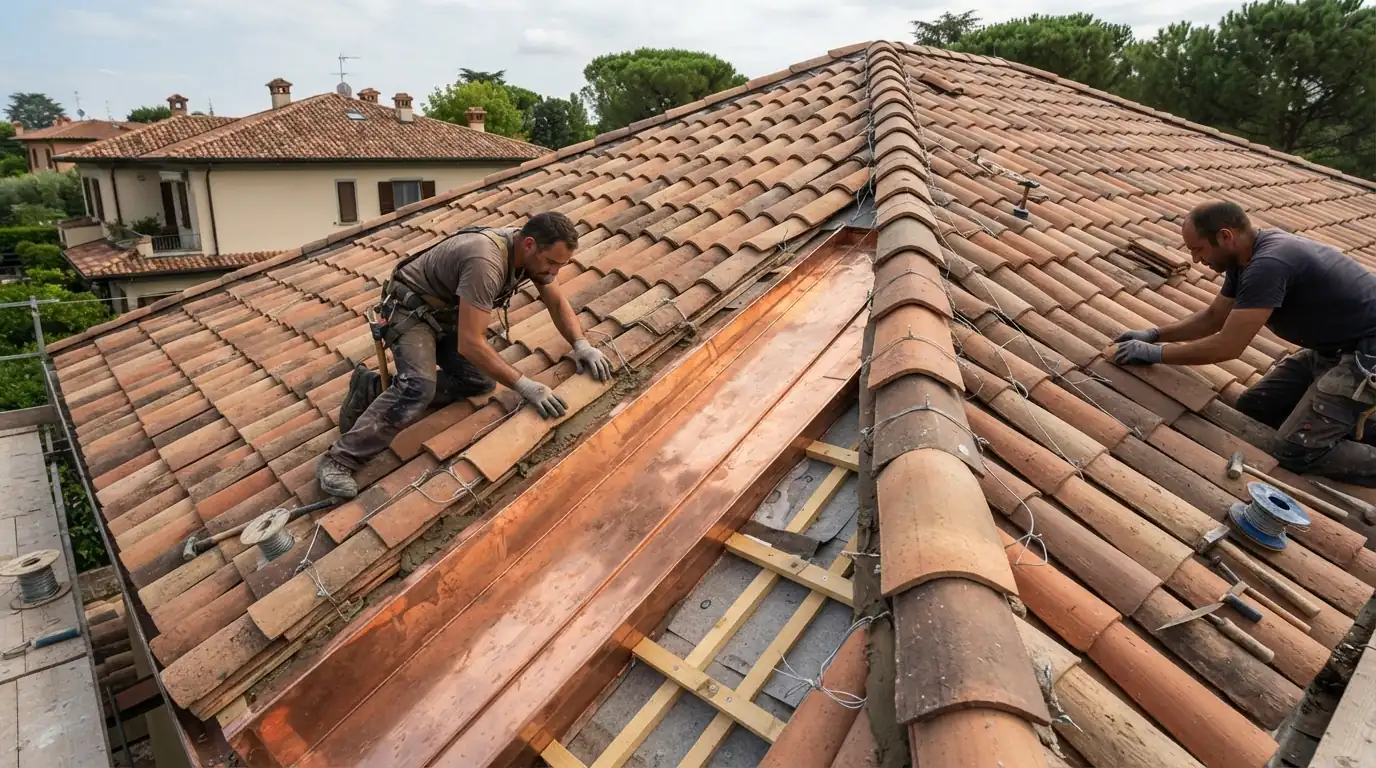
Clay barrel and Spanish tile is brittle to walk on and costly to replace, so every clay job starts with a salvage count. Reusable tile is cleaned and set aside; replacements are sourced to match color and camber as closely as the market allows. Clay is fastened with wire ties or nails through each piece, and the ridges and hips are bedded and pointed so they shed water rather than trap it. Where a clay roof has been patched with concrete tile, we pull those pieces and restore the clay.
Lift and relay with new underlayment
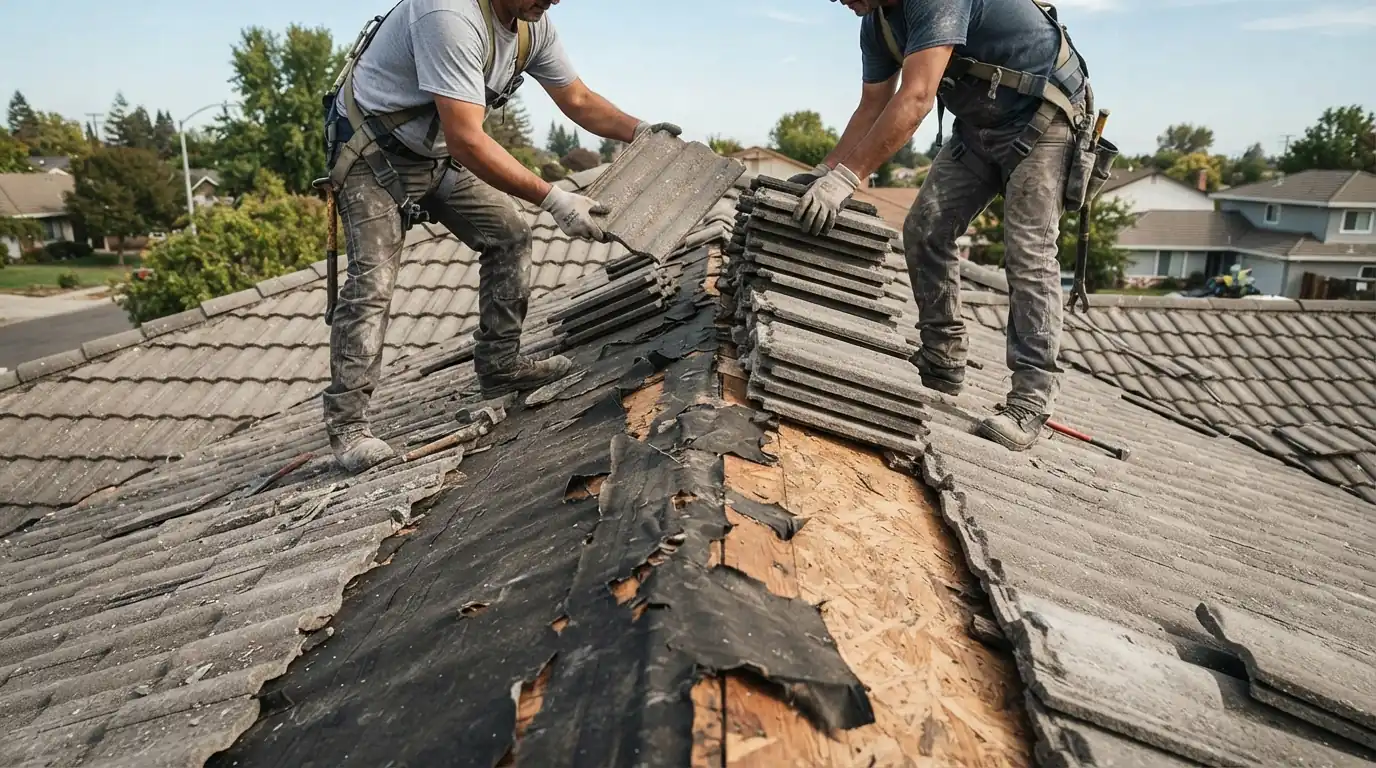
A relay lifts every tile, stacks it on the roof, strips the failed underlayment, and rebuilds from the deck up: new underlayment, new battens, new valley and wall flashing, new bird stops at the eaves. The original tile goes back down in its courses, with broken pieces swapped out. The roof looks the same from the street and performs like a new one where it matters, under the tile. A relay runs a day or two longer than a strip-and-replace because every tile is handled twice.
Structural review for tile weight
Tile weighs several times what composition shingle does, and changing profile or material changes the load on the framing. Before we quote a tile-to-tile change or a shingle-to-tile conversion, we check rafter size and spacing in the attic. If the new assembly crosses the city's weight threshold, the permit needs an engineer's letter, and we arrange it rather than leave it to the inspector to find. A shingle-to-tile conversion nearly always crosses that line; a tile-to-tile swap often does not.
Cost
What drives the cost of a tile re-roof
Tile work is priced after a salvage count, because the number of reusable tiles changes the job more than anything else.
- Relay versus new tile Reusing sound tile saves material; a new tile system costs more but resets the clock on everything.
- Breakage on the lift Older and clay tile breaks more when lifted; replacements are priced per piece.
- Underlayment system Two-ply or high-temperature synthetics cost more and last longer under tile.
- Flashing and valleys Metal valleys, wall and chimney flashing are replaced, not reused.
- Structural work An engineer's letter or added framing is needed when the assembly gets heavier.
- Roof shape Hips, valleys and dormers slow tile work more than they slow shingle.
What we see on San Jose roofs
Tile is a big share of the San Jose re-roofs we quote because so many Mediterranean and Spanish-style homes here were built with it, and tile adds real load compared with asphalt. California's seismic rules require review when a re-roof raises roof load by more than 10 percent, so a switch to a heavier profile is never just a color choice. When the framing is tight, lighter concrete profiles or stone-coated steel carry the look without the extra weight.
What happens after you call
How a tile re-roof runs
- 1
Salvage count
We lift sample tiles to see how many survive and what the underlayment looks like.
- 2
Relay or replace
You get both options priced when both are sensible.
- 3
Attic check
Rafter size and spacing are measured before any change of profile.
- 4
Lift and strip
Tile is stacked on the roof, the old underlayment and battens removed.
- 5
Rebuild
New underlayment, battens, flashing and bird stops, then tile goes back down.
- 6
Final and cleanup
City inspection, broken tile hauled away, spare tiles left for future repairs.
Brands we install and service
FAQ
Questions we get asked
Usually most of them. Concrete tile survives a careful lift well; clay breaks more. We confirm with a salvage count first.
The underlayment beneath has failed. Tile sheds most water, but the paper underneath is the real waterproof layer.
Only when the new roof is heavier than the old one or the framing is undersized. We check in the attic before quoting.
We pick the closest current profile and color. Exact matches to discontinued tile are not always available.
For the right house, yes. On lighter framing, stone-coated steel gives the look for less load.
Same category
Related roofing work
Roof Replacement
Composition shingle re-roofs with Class A and cool-roof options, permitted and inspected.
Learn moreFlat Roof Replacement
TPO, PVC and torch-down systems with tapered drainage for low-slope roofs.
Learn moreMetal Roof Installation
Standing seam and stone-coated steel, including over existing shingles.
Learn moreSpray Foam Roofing
New foam roofs and recoats for Eichler and other low-slope homes.
Learn moreFind out whether your tile can be saved
We lift a few tiles, check the paper and the framing, and price the relay and the replacement side by side.